
Just got a couple of new boards back (this was an experiment, expediting some of the boards to get them several days ahead of the rest of this prototype batch).
Meet the new JeeNode USB v3 (this unit was soldered by hand – phew!):
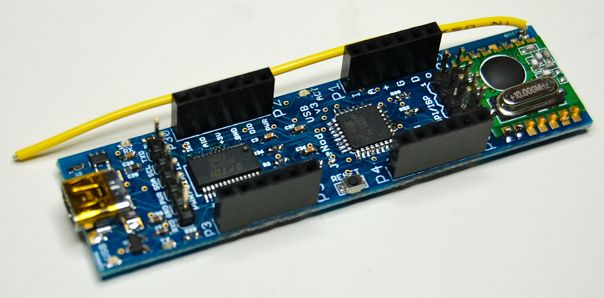
As you may know, the main reason for this revision was to resolve a problem with the voltage regulator, but since I had to rework the design anyway I also added a LiPo charge circuit.
The good news is that everything seems to work fine so far. There are some cosmetic problems with this board, but no show stoppers.
And of course the big deal is being able to hook up a Lithium Polymer (LiPo) battery:
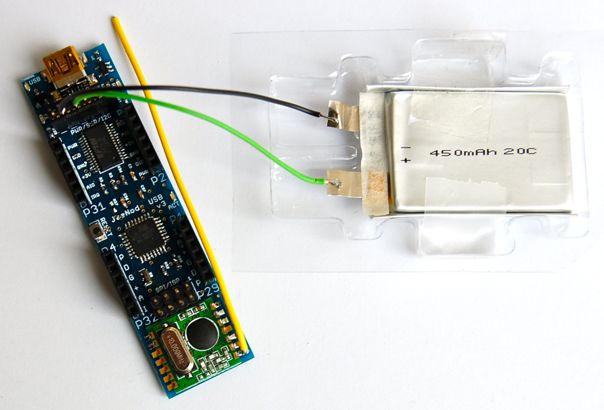
There is an extra LED in the corner, left of the USB jack, which will be orange (once I get them in). It lights up while charging. The charge current is max 280 mA, so this board won’t draw more than that from USB.
Without LiPo connected, the current still goes through the charge circuit, so another major change is that the PWR pin on all the headers of this board never carries more than 4.2V – don’t use the JeeNode USB if you need 5V in your circuit (use a JeeNode + USB-BUB if you really need the 5V).
Two BIG honking warnings, since LiPo batteries can be quite dangerous: one is that they need to be charged with the proper circuitry, such as on this new board, so don’t hook ’em up any other way. The other issue to keep in mind at all times, is that LiPo’s can discharge at a very high rate! That “20C” label above means that this particular little battery is rated to sustain a discharge @ 20 x 450 mA = 9 amps!
You can probably cause a fire with those wires shown above, by simply shorting out a fully charged battery!
And you will probably fry the circuit and vaporize PCB traces by connecting the battery in reverse!
I’m exploring some options to reduce these risks. Hard-wiring the LiPo would be one way to reduce the chance of loose wires shorting out something. Perhaps a small custom PCB glued to the battery, with a fuse or polyfuse and a switch, wrapped in heat-shrink tubing? The trouble is that battery sizes and capacities vary greatly.
Some first tests w.r.t. power consumption: it looks like the JeeNode USB v3 will draw about 120 µA when in sleep mode. With the above 450 mAh battery, it would last up to 5 months without recharging (and without doing anything useful, such as turning on the radio module once in a while). There’s probably still some room for improvement here, but for now it’ll have to do.
FWIW, I’m going to hand-assemble a few of these boards in the coming weeks, but unfortunately that means there won’t be many v3 units available in the shop, initially. I’m also having solder paste stencils made up right now. Once these are in, the new boards will be much easier to assemble – using the reflow grill that gets a lot of work done here at Jee Labs.
What is the name/stats of the lipo charger chip?
MAX1555
nice one.
I’d guess you plan on taking on your “self-sustaining solar node” again. (http://jeelabs.org/2009/07/03/mystery-jeenode/)
I’d love to see more of this coming.
just thinking a few steps further. Thought I do not know much about capacitors, but wouldn’t a capacitor as energy reservoir make this node even last over years. I mean even a LIPO cell will reach it’s end of it’s lifetime in what 1-2 year(s)?
like this one: (http://code.google.com/intl/de-DE/apis/gdata/articles/radish.html)
This would turn the node into a real self-sustaining node, there is no maintenance required (f.e. changing the LIPO cell once a year). Once the node is able to update itself via wireless (which is just a matter of time if not already solved), such a node could even run for 10+ years.
Yes, Lightly / the mystery JeeNode has been patiently sitting here, waiting for a better power solution. I may or may not use the JUv3 for this. The other option I’ve been wanting to explore is a simpler one – just short out to the solar cell when the LiPo is full. See http://jeelabs.org/2009/10/20/solar-power/
The capacitor you describe requires a “supercap” to store sufficient energy. These are not that much more economical than LiPo’s. I’m not sure LiPo batteries will last only 1..2 years in this context, since they are being charged/discharged at fairly low rates.
Nice link about Radish – thanks.
Note that harvesting solar energy indoor is hard. The levels of light are orders of magnitude less than out under the sun. See http://www.eevblog.com/2009/12/04/eevblog-48-solar-power-hope/ for an entertaining video about this.
just another link to such a supercap “battery” http://www.scribd.com/doc/17684600/SuperCap-Battery
Ok 2-3 years, should be fairly enought for every project i’d guess. http://en.wikipedia.org/wiki/Rechargeable_battery#Table_of_rechargeable_battery_technologies
I was more looking into a proove of concept mesh network of small and cheap nodes.
hmm on vacation and thinking about wireless mesh networks not good
Looking forward to seeing the LiPo charger on a ‘normal’ JeeNode.