
Got myself an Arduino Mega – an Arduino on steroids:
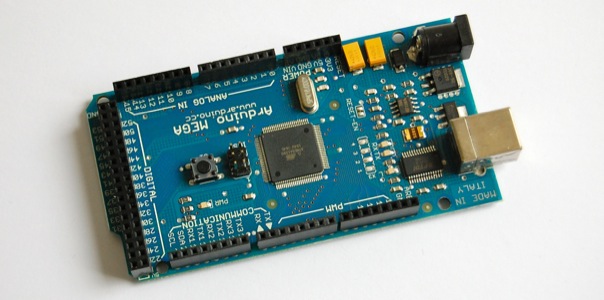
Compatible with current Arduino shields, but extended to support a lot more pins.
Ordered it from NKCelectronics, along with their new extended shield for it:
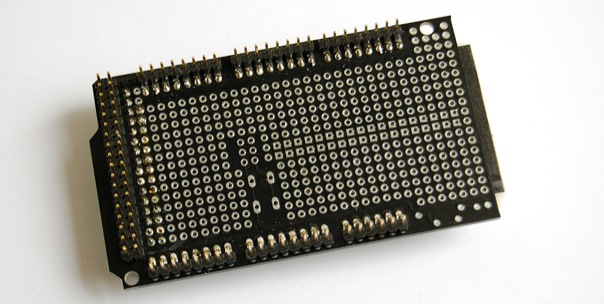
There’s a lot of them pins on there…
I decided to attach a solder-less breadboard to it, to be able to experiment with projects which need more I/O lines or comms than a standard Arduino:
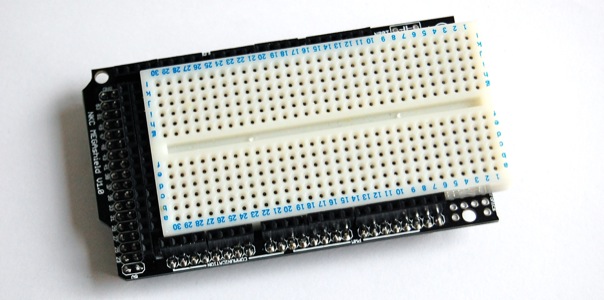
It fits, but just barely. Had to cut off the little hooks on the plastic. Using a breadboard in this way covers up all the identifying pin texts on the silkscreen, alas.
Actually, it doesn’t quite fit – couldn’t get all headers on:
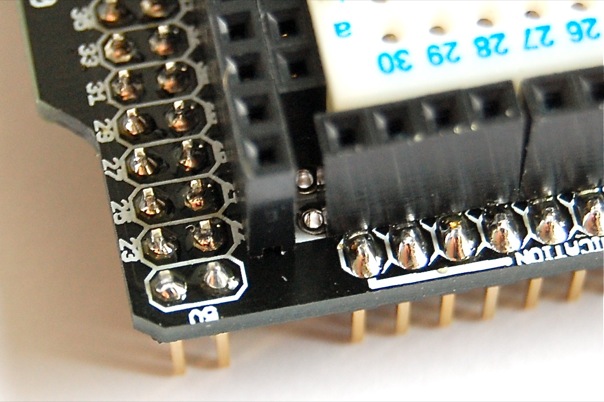
I’m using a mix of 4- and 6-pin headers, since I had them lying around. As you can see, the last 4-pin header makes it impossible to fit that other header in, so I left off pins 22 and 24. It might have worked with an 8-pin header i.s.o. 2x 4-pin.
And here’s the final “stack”:
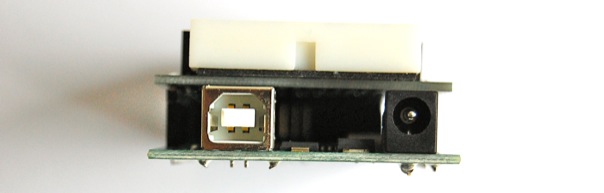
Conclusion so far? I’m not sure this is the way to go. I think it’s an abomination, to be honest. There are so many pins to connect that the two boards are very hard to separate once stacked up. You don’t want to pull too hard on one side and end up with bent pins when the thing finally comes apart.
And how often do you need that many I/O pins one one fixed board setup? Sure, the ATmega1280 has 128 Kb of flash memory, which is plenty to get fairly complex sketches going. But it also builds on that trend of using stacked shields – and let’s face it: a single shield is often great, but with 2 or 3 you end up with pin allocation nightmares (for designers) or conflicts (for users). Multi-stacking is tricky, requiring special stacking headers.
Nah, I’d much rather go with ports, and extensions for that, and connecting two or three independent units over a bus if need be. But then of course I would, that’s why I went for such an approach with JeeNodes after all.